
What you actually need to know.
- The Citadel itself was begun in 1176 by Salah al-Din (Saladin) on a Mokattam spur. Multiple expansion phases through Mamluk and Ottoman periods.
- Three museums currently open inside the walls: Police Museum, National Military Museum, Carriage Museum.
- The Police Museum is in the Mamluk Striped Palace area; the Military Museum is in Muhammad Ali's nineteenth-century Harem Palace (Haramlek); the Carriage Museum is in a former royal stable building.
- You can do all three in a half-day if you start early. Combine with the Mosque of Muhammad Ali on the same ticket.
- Allow ten extra minutes per museum for security and pace transitions between the museums and the open Citadel grounds.
The setting, in one paragraph
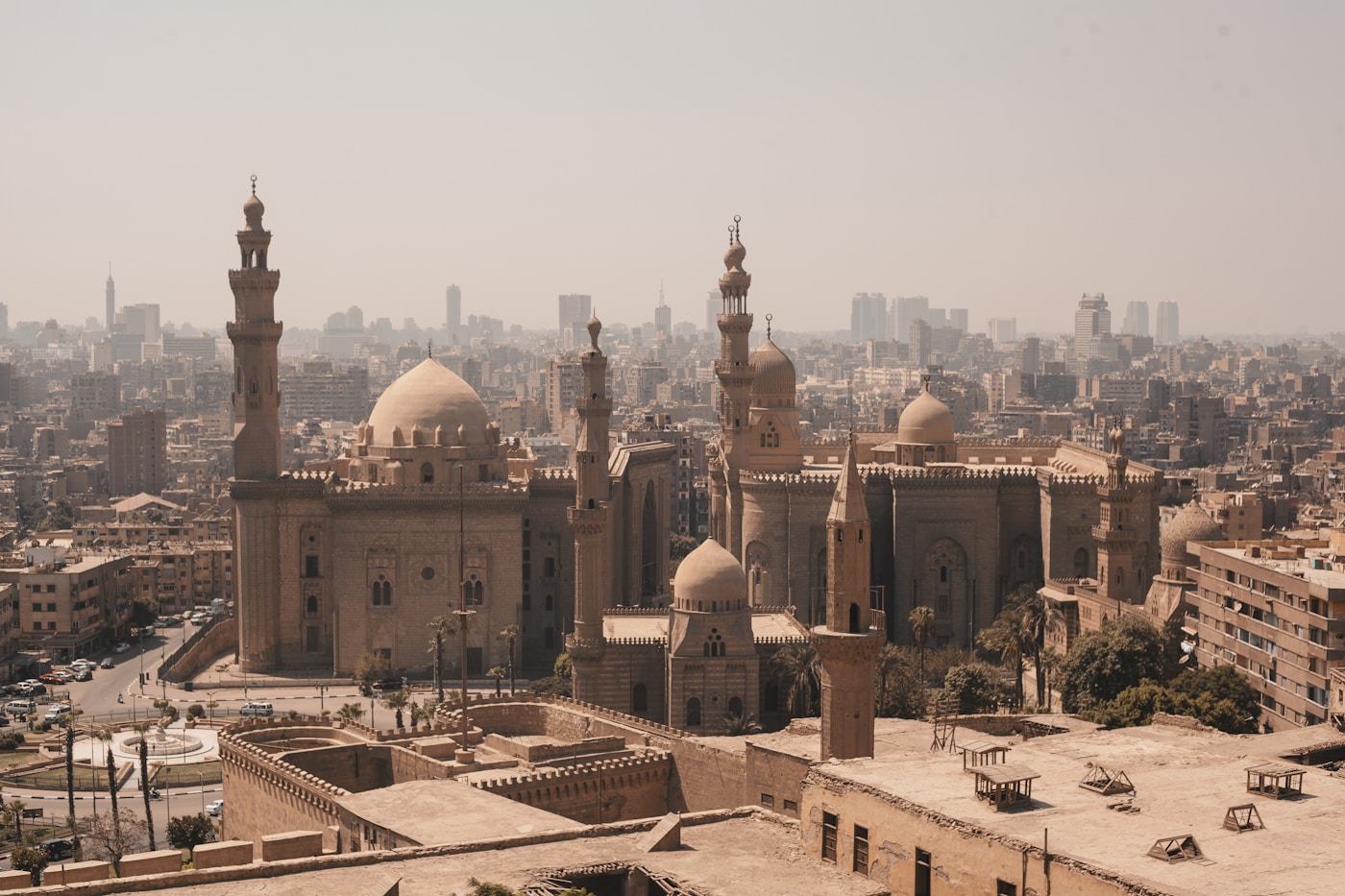
The Citadel sits on a spur of the Mokattam hills overlooking medieval Cairo. Saladin began construction in 1176 to consolidate Fatimid Cairo and Fustat into a single defensible enclosure; subsequent expansions came under his nephew al-Kamil, the early Mamluks, the late Mamluk sultan Qaitbay, and especially Muhammad Ali (1805-1849), who rebuilt large portions of the southern enclosure in a hybrid Ottoman-French style. The Citadel functioned as the seat of government from the late twelfth century until 1874, when the Khedive Ismail moved his court to Abdin Palace.
Museum 01 — The Police Museum
Where it is
In the northern enclosure, in a single Mamluk-era building that was once part of the Striped Palace (Qasr al-Ablaq), the great audience hall built by Sultan al-Nasir Muhammad in the early fourteenth century. The Striped Palace itself is mostly gone; what remains is the museum.
What's in it
An eccentric collection of policing material from pharaonic times to the present, organised in roughly five rooms. The first room covers ancient Egyptian policing — Old Kingdom inscriptions referencing law-enforcement officers, copies of New Kingdom documents on judicial procedure. The middle rooms cover the Ottoman and nineteenth-century periods, with uniforms, documents, photographs, and a substantial collection of equipment. The last room covers the twentieth and twenty-first centuries, with a focus on famous Egyptian criminal cases of the early twentieth century.
Why it's interesting
It is not, strictly, a great museum, but it is the only museum in Egypt that takes the history of law enforcement and crime as its subject, and the early-twentieth-century cases — Raya and Sakina, the two sisters convicted in 1921 of multiple murders in Alexandria — are documented here in unique original-source material.
Time required
Forty minutes, brisk. An hour if you read everything.
Museum 02 — The National Military Museum
Where it is
In the Harem Palace (Haramlek) of Muhammad Ali, built 1827, redecorated under Khedive Ismail in 1872, and gifted to the Egyptian armed forces as a museum in 1949. The building is the dominant southern structure inside the Citadel and is itself the principal exhibit.
What's in it
The largest military collection in Egypt, organised chronologically across approximately twenty rooms on two floors. Pharaonic warfare on the lower level (chariotry, weapons, models of the Battle of Kadesh), Greco-Roman and Coptic-period material in the next rooms, then a substantial Mamluk and Ottoman section (the Mamluk arms collection is particularly strong), then a long nineteenth and twentieth-century section covering Muhammad Ali's army reforms, the 1882 occupation, the world wars, the 1948-1973 wars, and the present armed forces. The Yom Kippur / October 1973 War room is the museum's institutional centre.
The building itself
The Harem Palace is one of the best surviving examples of nineteenth-century Egyptian state architecture. Painted ceilings, parquet floors, original gilt furniture in some rooms. The building merits as much attention as the exhibits. Photography is generally permitted in the galleries but restricted in some of the political-history rooms.
Time required
Two hours minimum, three if you take the building seriously.
Museum 03 — The Carriage Museum
Where it is
In a former royal stable building near the southern enclosure, between the Military Museum and the eastern wall.
What's in it
Thirteen royal carriages used by the Khedives and the kings of Egypt from Muhammad Ali to King Farouk. Some are state coaches built in Vienna and Paris in the late nineteenth century; some are everyday driving carriages. The collection is small, often closed for short periods, and rewards twenty minutes if you happen to be in the southern enclosure anyway.
Time required
Twenty to thirty minutes if open.
The recommended walking order
| Step | Where | Time |
|---|---|---|
| 1 | Enter through the main gate (Bab al-Gabal). Turn right toward the southern enclosure. | 0 min |
| 2 | Mosque of Muhammad Ali — five minutes inside, mostly to look at the dome and the courtyard. | 5–15 min |
| 3 | National Military Museum (Harem Palace). | 2 hours |
| 4 | Carriage Museum if open. | 20–30 min |
| 5 | Walk north across the open grounds to the Police Museum. The walk itself is one of the best inside-the-Citadel views — Old Cairo and the pyramids of Giza visible on a clear afternoon. | 10 min walk |
| 6 | Police Museum. | 40–60 min |
| 7 | Exit through the same gate. | — |
What is also inside the Citadel but not a museum
- The Mosque of Muhammad Ali — Ottoman-style, dominant southern profile of the Citadel from the city below.
- The Mosque of al-Nasir Muhammad — early Mamluk, fourteenth-century. Smaller, austere, often empty. Worth fifteen minutes.
- The Mosque of Sulayman Pasha al-Khadim — sixteenth-century Ottoman, in the northern enclosure. Fifteen minutes.
- The Bab al-Azab gate area, containing the steps where Muhammad Ali's massacre of the Mamluk leaders took place in March 1811.
What is not currently open
The Mansoura Battle Panorama and a small Coptic-period archaeological room have both been closed for refurbishment at various points in 2024-2026. The Harem Palace's southern terrace was closed for safety work in early 2026; check at the entrance whether it has reopened.
One paragraph of opinion
The Citadel's three museums are uneven. The Military Museum is excellent and sometimes brilliant; the Police Museum is eccentric but rewarding; the Carriage Museum is small. The argument for visiting all three is the building they sit in.
The Citadel itself is, after the pyramids, the best half-day in Cairo. The museums are the way to read it. The Military Museum's nineteenth-century rooms tell you who built the Harem Palace and why; the Police Museum's nineteenth-century cases tell you what kind of state was being administered from this hill; the Carriage Museum tells you, in thirteen carriages, what the family that built it spent its money on. The Citadel is the spine of modern Egyptian state history, and the museums are footnotes to it. Read them as footnotes.
Practical context, in two notes
Where it is: the Citadel of Saladin, southern Old Cairo, on the eastern edge of the medieval city. The closest metro is Mar Girgis (Line 1) — about twenty-five minutes' walk uphill, which I do not recommend in summer. Most visitors take a taxi from Sayyida Zeinab metro or directly from a hotel. Ride-hail apps work reliably to the Citadel main gate.
How long to allow: a half-day for the three museums plus the principal mosque. A full day if you also intend to walk the medieval streets at the foot of the Citadel afterwards.
Briefing 02 of 5. Last revised 21 April 2026.